Sitaram Dewan Chand’s Chhole Bhature

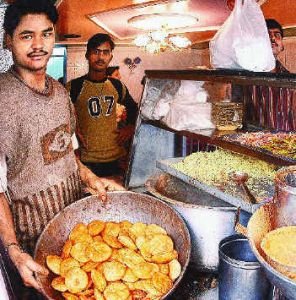
Sitaram Dewan Chand’s shop is a small affair, but with the facility of tables on the pavement outside, at which you can stand and eat.

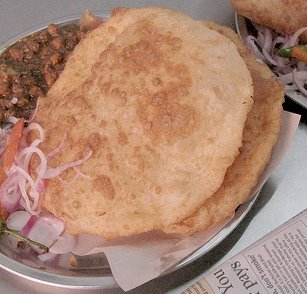
Sitaram’s fresh bhature are quite as soft and fluffy as those at Nagpal’s. But they certainly trump Nagpal in the taste department. For one, the bhature are even more liberally stippled with paneer shreds. But that is not all that makes them so special — it is also the fresh coriander, and the variety of spices (including fennel, pomegranate seeds, and others that I couldn’t unravel) that are mixed into the flour.

Of course, the zesty chhole, served with green chillies and onions, are a favourite in of themselves.

Location: The address is 2246, Chuna Mandi, Paharganj. This is on the street (technically, “Rajguru Marg”). The shop is on the ground floor of the building which houses Hotel Chanakya.

Timings: 8am to late afternoon

Share/Bookmarka2a_linkurl=”www.barfanibaba.com”;

Natraj Dahi Bhalle Wala

Natraj Dahi Bhalle Wala- talk about a functional name! This little kiosk in Chandni Chowk is surely reaping the benefits of specialization. At 20 bucks a plate, I don’t mind driving 50 kilometers and waiting in hour long queues for my fill of these blissful dahi bhalla’s. Natraj is almost a landmark in Chandi Chowk, so, finding the place isn’t too hard.
Dahi Bhallas which have been selling like hot cakes since the past 50 years. Soft, creamy and scrumptious, these are a must-have for every foodie.
You cant miss it, as you come out from the Chandni Chowk Metro Station, the narrow lane just passed thru in front of this shop. Things changed, but not at Natraj.

1396 , Chandni Chowk , Delhi- 110006
Near Central Bank

Share/Bookmarka2a_linkurl=”www.barfanibaba.com”;

Japani samosa – Lajpat Rai market, Old Delhi

Delhi’s really unique samosa is not your regular triangular flour puffs. It is the Japani samosa found in an Old Delhi lane.

A Japani samosa is actually not a true-blue samosa. It certainly does not look, taste or behave like the conventional samosa. It’s a big, layered puff pastry – something like a cheese puff – with a delicious filling of lightly spiced potatoes and peas. The samosa is doused with a layer of chholey – and the two together are like those unforgettable pairs of Hindi cinema – say, Raj Kapoor and Nargis, or Dilip Kumar and Madhubala. Or, if you insist, Govinda and Dilip Dhawan.

Walk up to Jama Masjid and then take a rickshaw to Moti Cinema Hall. After getting down at the mouth of Dariba, the old silversmiths’ hub, take the road between Moti Cinema and Lajpat Rai Market. And right there is Manohar’s Japani Samosa.

Poetic logic?
Nobody quite knows why the samosa is called Japani. Umesh, the friendly owner, doesn’t know the reason, but knows that it has been called so since its very inception in 1949.

The crispy outside and the soft inside of the samosa sum up an interesting bite. The bland pastry goes well with the vegetable filling. And the chholey leaves its tangy taste behind.

Share/Bookmarka2a_linkurl=”www.barfanibaba.com”;

Dhai Bhalley – Asaf Ali Road

If you take the straight road, under the Minto Bridge, from Connaught Place to Asaf Ali Road, you will find the dahi bhalley man on the left immediately after a small roundabout. There is no signboard, and no glittering neon lights, but you know you are at the right spot because of the crowd around him. The dahi-bhalley wallah is surrounded by several earthenware pots, or matkas. One has curds in it, another has the sweet-and-sourwater that goes into golgappas.
What makes him different from the other papri-chaat that you get in different parts of the city is the lavish use of ginger in his chaat. My dahi-bhalla papari (Rs.15 for a plate) consisted of one large dahi bhalla. He had layered this with thin slivers of ginger. On top of that came a layer of papri. To this he added a fistful of boiled chickpeas and cubed potatoes. And then came the curds, followed by green and red chutneys.

Share/Bookmarka2a_linkurl=”www.barfanibaba.com”;

Dinesh Kachoriwallah at Nai Sarak

My favourite kachoriwalla is the one on Nai Sarak. For one, Dinesh Kachoriwallah makes some of the best kachoris in town. And two, he is there to be found – sitting at the mouth of Katra Jamun – through most of the day. You will find it easier to locate him if you approach Nai Sarak from Town Hall. The kachori stall is just 200 yards down the road.
Steady pricing
Dinesh has one tiny place and he sells kachori-sabzi there just like his father and grandfather did years ago. Happy to find that when the cost of everything around us is spiralling, two of his kachoris still come for a mere eight rupees. Dinesh hadn’t failed me. His kachoris are still as good as they used to be: perfectly deep-fried with a mouth-watering stuffing. The outer skin is crunchy and crisp, and the vegetable that comes along with it is hot to the touch and taste.

Moth kachori from that little known shop in Multani Dhanda

Moth – which is essentially a dal, a bit like moong – is something that challenges all those who think that street food in the city starts and ends with papri chaat. Moth, in fact, has over the years been added to Delhi’s culinary tradition. The city’s eating habits record the history of turmoil. The influx of refugees into Delhi after the Partition of India changed the food culture of the city forever. Since most of the refugees were from West Punjab, the cuisine began to change along with the city’s own metamorphosis. The refugees were gutsy eaters from Punjab and the Frontier areas of today’s Pakistan and left their mark on what is known as the food of Delhi.

Multani delight
The Multani moth is one such chapter. The place is tucked away in the heart of the city. The North End Road from Gole Market, across Panchkuian Road, connects to the Deshbandhu Gupta Road crossing, with the Paharganj police station on the left. A right turn on Deshbandhu Road – towards Sheila Cinema – and a left from The Kashmiri Sweet Shop lead to the Multani Moth Bhandar. The place is on the left in gali number six of Multani Dhanda.

It’s a small, inconspicuous shop doing great business. There are artistes at work here, for each plate of moth is prepared lovingly and painstakingly. A huge patila opens up to give a tantalising vista of steaming moth. The dish goes like this: first, a layer of cooked rice is put in a donga, on top of which the moth dal is placed in another layer. A pinch of Multani masalas is sprinkled on top of the mound, and some slices of sour raw onions are placed around it. And instead of a spoon, you use two crisp kachoris to scoop out the moth.

The moth has a uniquely delicious taste – it’s both crunchy and velvety like a good dal ought to be. It is spicy, but not chilly hot. And at Rs.10 a plate, it is real value for money.